
#76 | Voice AI – ChatGPT can finally say mhmm & listen
TL;DR: GPT-Live can listen and talk at once, and quietly hands hard questions to a smarter model mid-sentence. It also learned to say “mhmm.” Here’s what that’s actually good for.
👋 Hello,
Somewhere inside OpenAI, someone spent real engineering time teaching a voice model to grunt.
A small “mhmm” while you’re still talking, so you know they heard you and didn’t hang up mid-thought.
Well, that’s just a fun detail about the new GPT-Live, the July 8th release that now runs ChatGPT’s voice mode.
The model is easy to describe in spec-sheet language. Full-duplex architecture. Delegation to a background model. Nine remastered voices.
The “mhmm,” though, is the part that tells you what they were actually trying to build. A better listener, who seems to grunt.
To better understand why that actually matters, here’s the plain version of what changed.
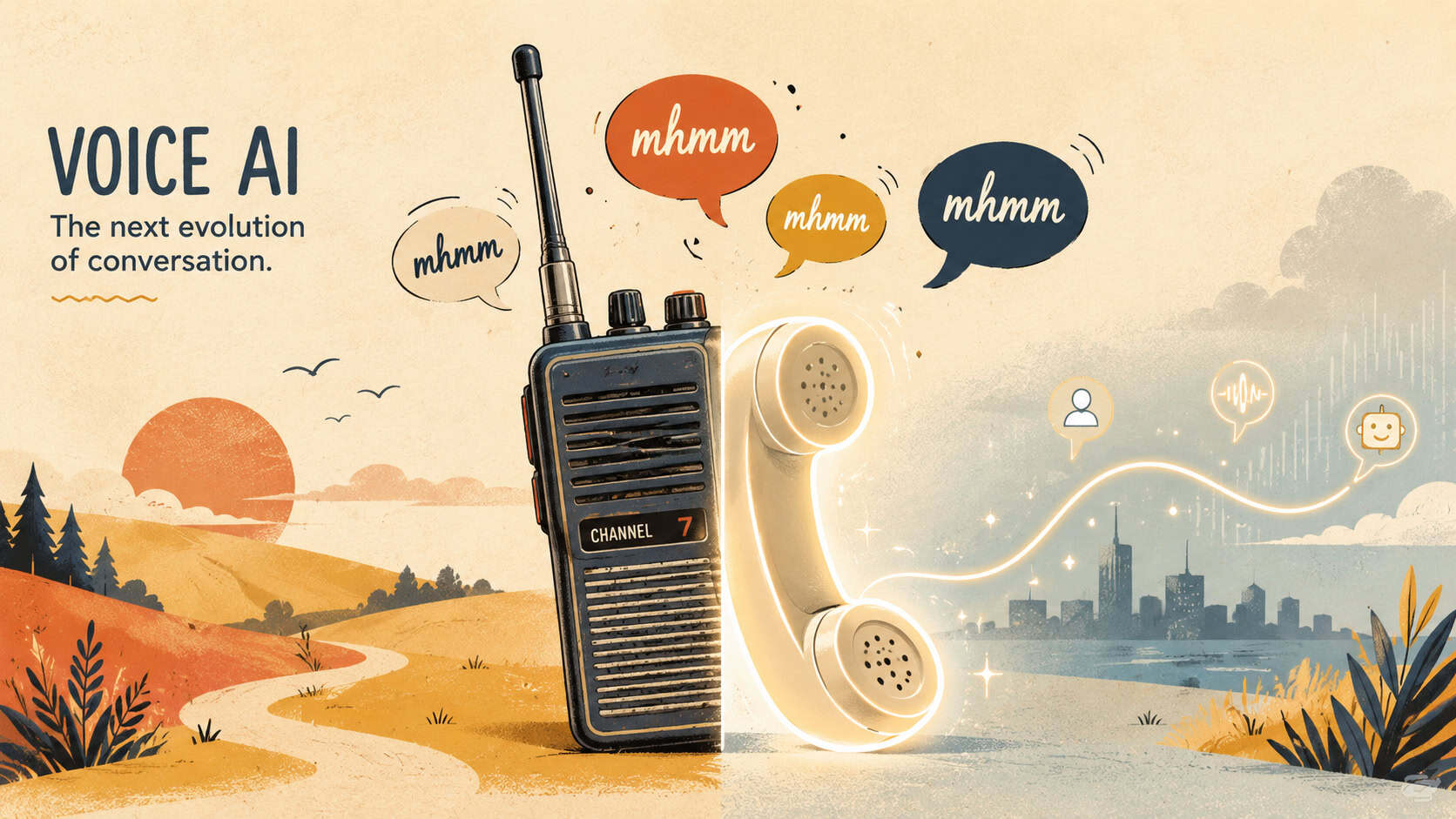
The old voice mode you are familiar with worked like a walkie-talkie. You talk, you release the button, then it talks. Wait your turn, every time, even mid-thought.
GPT-Live works more like an open phone line. It’s listening while you’re still forming the sentence, and it can decide, several times a second, whether to speak, stay quiet, or wait for you to finish.
OpenAI says it can also just sit there and absorb what you’re saying without needing to jump in. It may sound like a small thing until you notice how rare that is in anything built to respond.
The second change matters even more in practice, and it’s easy to miss because it’s less visible.
When a question needs real thinking, a web search, something GPT-Live isn’t built to handle on its own, it hands the question off to a separate, more capable model running in the background.
The conversation doesn’t pause while that happens. It just keeps going, and the answer folds back in when it’s ready.
Simon Willison, an independent AI developer who had early access, described using it for an hour-long walk with his dog, at one point trying to ask where owls go before dusk.
The model apparently found this hilarious for reasons nobody could quite explain, laughing mid-sentence at something that wasn’t a joke.
They fixed it, but it’s a good reminder that it is still new enough for those seams to show.
The AI Learning Guy newsletter 🤖 🧠💡
AI learning hacks and mega prompts delivered to your inbox.
What’s it actually good for?
That’s the part I’ve been sitting with, because I haven’t used voice much myself. I type. Typing is how I think.
My daughter is one, though, and the enter key has become her favorite toy, usually mid-sentence, usually mine. Circling voice, for me, isn’t about dictation. It’s about the moments when my hands are full and a thought is trying to get out anyway.
That’s where the real opportunity lies, and it’s narrower than the launch coverage suggests.
Talking through a problem out loud works differently from typing it. You interrupt yourself less carefully in speech, so the messier version of the idea comes out first, before you’ve had a chance to tidy it into something safer.
That messiness is usually the honest part. Turning it into a sparring partner takes more than switching the toggle on.
The default lean of most voice assistants, this one included, is toward agreement. You have to ask it directly to push back if that’s what you actually want.
Reading your own writing back to it does something text alone can’t, because hearing a clumsy sentence out loud gives it away in a way scanning it silently never quite manages.
A real critical review works the same as the sparring: it won’t volunteer friction. You have to ask for it, plainly, the way you’d ask a colleague to stop being polite.
None of that is a full paradigm shift. AI voice tools are just getting less annoying to use, which is its own kind of progress. Quietly, the way most real progress happens.
I think about Alexa here, briefly, since a fair number of us have some version of that particular frustration filed away somewhere.
Ask it something slightly off-script, and it either mishears you or confidently answers a question you never asked, in a tone that treats this as a success.
That’s the ceiling GPT-Live is trying to break through, not by getting a better ear, but by decoupling the listening from the thinking. So the part doing the listening doesn’t also have to be the part doing the reasoning.
Whether that holds up outside a controlled demo is still open. GPT-Live is just two days old.
There’s no video or screen sharing at launch, even though the older voice mode had them, so this version is narrower in one real way while broader in another.
The reasoning-depth setting, Instant, Medium, or High, matters if you’re going to use this seriously. Instant trades depth for speed, and High is the one you’ll want for anything resembling real work.
More than 150 million people already talk to ChatGPT by voice every week, stiffness and all, which tells you the appetite was there long before the interface deserved it.
What changed is the friction, not the appetite. The interface stopped getting in its own way as often.
I don’t think this is the version that matters most in the long term.
GPT-Live is this year’s answer to a question that’s going to keep getting asked, and something else will replace it, probably sooner than feels reasonable.
The skill worth building has nothing to do with loyalty to this particular model.
It comes down to knowing, concretely, what you’d use a genuinely fluid voice conversation for, so the next version doesn’t find you starting from zero again.
For me, that’s brainstorming while my hands are occupied, sparring when I want resistance instead of agreement, and reading my own writing back to catch what I can’t see on the page.
Your list will look different. Build it anyway.
Cheers,
Mark
The AI Learning Guy
👋⚡😎
The AI Learning Guy newsletter 🤖 🧠💡
AI learning hacks and mega prompts delivered to your inbox.
Interesting Sources
- OpenAI’s official GPT-Live announcement: Introducing GPT-Live
- TechCrunch’s coverage of the July 8 briefing: TechCrunch report
- Simon Willison’s early hands-on notes: Introducing GPT-Live
- SiliconANGLE on model naming, tiers, and evaluation scoring: SiliconANGLE coverage
Note: No single website has all the answers. This list serves as a starting point for those who want to explore or satisfy their curiosity about AI. Links: Links with * are affiliate links. See disclosure below.