
#55 | Is AI a bubble? Your money’s already in it.
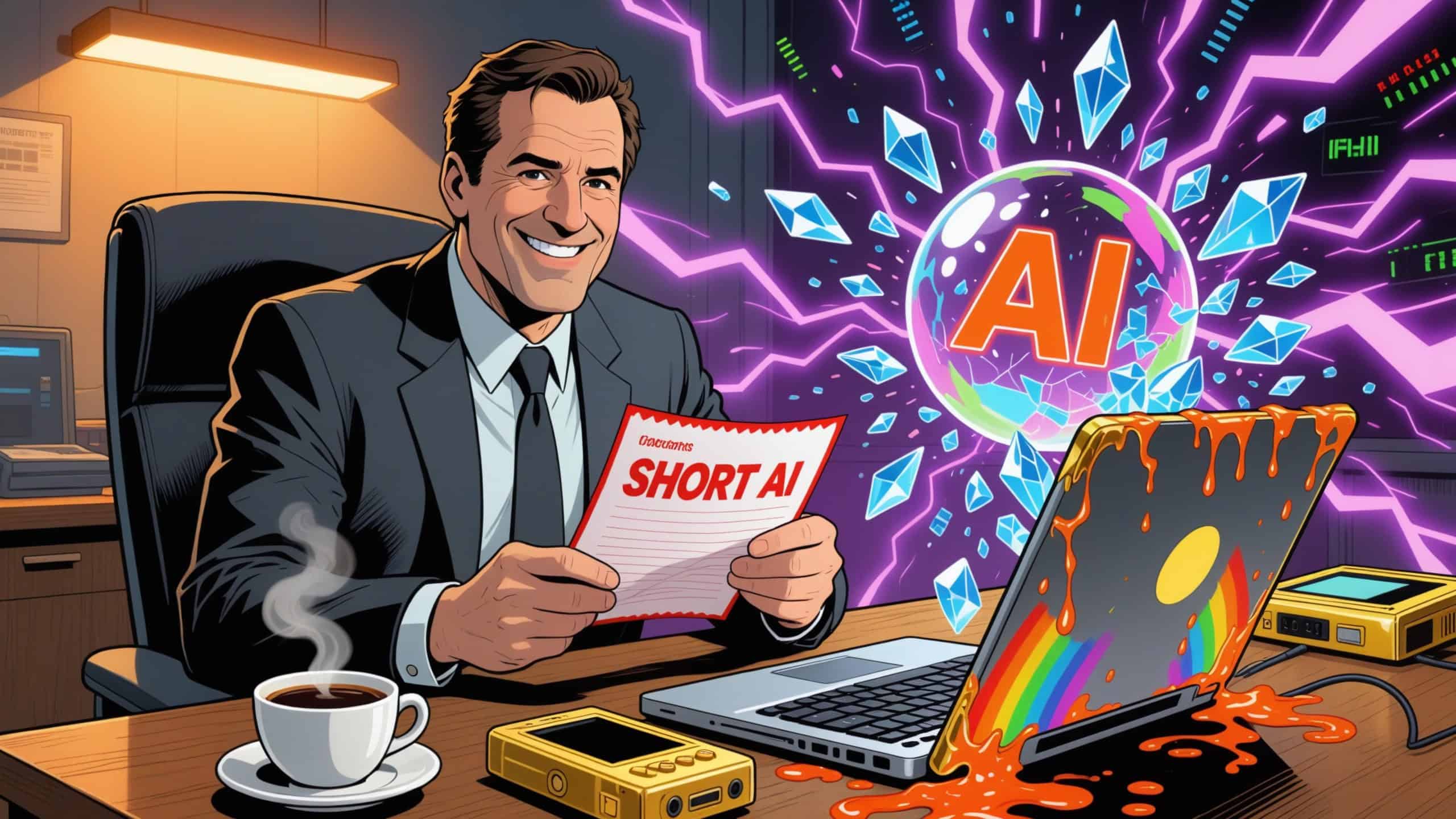
TL;DR: Michael Burry bet against AI companies. AI bubble or breakthrough, your retirement account, your work, and your morning routine already carry more AI exposure than you might realize. Here’s what that actually means.
👋 Hello,
Michael Burry just bet against AI.
You know—the guy who predicted the 2008 housing collapse. Made $100 million personally, $700 million for his investors. Got so much pushback that he almost got fired. Then turned out to be entirely right. Just three years early.
Now he’s disclosed put options against Nvidia and Palantir. If you’ve never heard of put options, well, they’re essentially bets that stock prices will fall. So the headlines screamed “$1 billion bet against AI.”
But hang on: Is that the actual money Burry risked? Not quite. Closer to $10 or $50 million (I’ll explain below). There is always a gap between what sounds true and what is actually true, isn’t it?
Anyway, four days before anyone knew about his [bet] positions, Burry broke two years of silence on X. He posted a scene from “The Big Short” with text: “Sometimes, we see bubbles. Sometimes, there is something to do about it.”
And why does this matter again? Well. What happens to your work, your savings, and your Tuesday morning if these AI investments don’t deliver what the markets have priced in? And what if they do deliver—just not the way anyone expected?
Whether you’re tracking this story or not, AI has reached a scale where its success or failure will reshape labor markets, retirement timelines, and resource allocation. Thus, more and more people will be affected by AI’s successes and failures, whether positive or negative.
And here’s an uncomfortable bit—your retirement account and/or ETF world fund probably holds somewhere between 30 and 40 percent in technology stocks right now. Mine does too. You didn’t wake up one morning and decide, “Yes, concentrate a third of my future in seven companies.” It just happened through index funds.
They call it diversification, which feels a bit like calling a meal balanced because it has three types of sugar.
Meanwhile, entry-level jobs are disappearing faster than at any point since 2020. Over 100,000 this year. Data centers now consume four percent of America’s electricity. By 2030, projections suggest that it could hit twelve percent.
These aren’t forecasts. They’re measurements from MIT, the Bank of England, and the IMF. Institutions that typically avoid drama. But let’s dig a bit deeper.
The AI Learning Guy newsletter 🤖 🧠💡
AI learning hacks and mega prompts delivered to your inbox.
The mechanics of the bet
So, Burry’s hedge fund filed its 13F disclosure with the SEC on November 3rd. Put options on Nvidia—the company that makes the chips powering AI systems. And put options on Palantir, which builds AI software for governments and enterprises.
Together, the positions controlled $1.1 billion in notional value. However, notional value refers to the total worth of shares that these options control, not the actual amount spent. When you buy puts, you pay a premium—typically one to five percent of the notional value—for the right to sell at a specific price later.
So, his actual capital at risk? Somewhere between $10 and $50 million. For a hedge fund managing hundreds of millions, it’s a calculated position, not an existential bet.
His timing hasn’t always been clean. He nailed the housing crisis but spent three years getting yelled at by investors before the crash proved him right.
Both companies he’s betting against crushed earnings in Q3. Palantir’s revenue jumped 63 percent, exceeding the 50 percent analysts had expected. Nvidia became the first company ever to cross $5 trillion in market value (going rather well).
Yet warnings keep stacking up. The Bank of England said valuations “appear stretched.” Goldman Sachs and Morgan Stanley CEOs both predicted ten to twenty percent corrections within two years. Multiple signals. But no consensus yet.
What the numbers actually show
In September 2025, Nvidia announced plans to invest up to $100 billion in OpenAI to finance the construction of AI data centers. OpenAI will use those funds to build centers that purchase millions of Nvidia chips.
I wrote about this topic in our newsletter edition #49.
Ok, so this structure—vendor financing—has historical precedent. Late 1990s: Lucent and Nortel lent money to telecom operators so they could buy their equipment. Both companies later filed for bankruptcy.
The question is whether revenue growth driven by circular capital flows represents genuine demand or just capital recycling through the system.
MIT researchers found that 95% of organizations deploying generative AI report no measurable financial return. Despite investing $30 to $40 billion, only five percent of pilots generate actual business outcomes. The gap between investment and results remains significant.
Then there’s reliability. AI models still tend to hallucinate frequently, providing incorrect information up to 30-35 percent of the time, with some newer models being even more prone to errors. It looks like hallucination is to stay.
And newer models are making more errors. Really? That’s not how technology typically progresses, right?
However, enough progress has been made to cut over 100,000 tech jobs in 2025. Entry-level positions are vanishing fastest, and college graduate unemployment now exceeds five percent.
The pattern we can see here is that investment is rising, returns are (still) missing for many, jobs (nevertheless) are disappearing, and AI technology and AI markets are becoming (somewhat) unpredictable. Wild times.
The AI Learning Guy newsletter 🤖 🧠💡
AI learning hacks and mega prompts delivered to your inbox.
If the AI concerns prove valid
So, what happens (or may happen) if Burry turns out to be right?
According to Brookings Institution research, retraining systems would require a 400 percent capacity expansion to handle displacement at the projected scale. That’s not a minor adjustment.
Companies that have heavily invested in AI without seeing returns have already begun cutting staff. The pattern so far goes like this: entry-level positions disappear first, mid-career roles follow, while senior positions with judgment and relationship responsibilities hang on longer. Will those companies survive?
Now let’s talk about your money. State pension funds typically have an average funding level of 75%. Many lean on tech stock growth to meet obligations. A twenty percent correction on $200,000 means $40,000 gone. And historical recoveries from similar corrections—such as the dot-com crash from 2000 to 2003—took five to seven years.
Daily life shifts might feel smaller at first, but they accumulate. Free AI services currently burning cash to capture users would likely pivot to paid models or shut down. Let’s hope we didn’t entirely build our business models or personal finances around them.
Also, two-thirds of new data centers built since 2022 have been in water-stressed regions. Those areas already report tensions related to water access.
By 2030, AI infrastructure is projected to consume twelve percent of U.S. electricity, up from four percent. Water consumption could triple. That’s a general concern no matter what.
Whether AI succeeds or stumbles, the environmental infrastructure gets built now. The bill comes due regardless of the outcome.
If AI adoption continues
But let’s also look at the other side of this.
Some sectors are showing real productivity gains. Legal research, coding assistance, and customer service automation are demonstrating 20 to 40% efficiency improvements in successful deployments.
AI tech works in specific, bounded contexts.
Yet even successful AI adoption creates friction. The World Economic Forum projects that 92 million job roles will be displaced by 2030. But, they also project 170 million new positions created—a net gain of 78 million jobs.
But. Here’s the BUT: those new roles require skills not yet taught in most educational programs.
Being “an AI user” becomes baseline, not an advantage. Like email proficiency today. The value shifts to judgment, context, relationship depth—the parts that remain distinctly human. Output, not outcome, matters. (see edition #53)
In general, AI productivity appears to benefit clusters around workers earning $90,000 or more annually. Lower-wage workers face a higher risk of displacement without equivalent access to productivity tools.
This creates what economists call K-shaped outcomes: some trajectories rise sharply, others decline. Distribution gaps widen regardless of whether we’re in a AI bubble or witnessing a genuine breakthrough.
Cambridge researchers estimate tech sector energy demands could rise 25 times by 2040. And here’s the calculation nobody can answer yet: Will AI’s contributions to climate solutions outweigh its climate costs?
What you can act on versus what you can’t
So let’s get practical about what you actually control here.
Start with your portfolio exposure. Most brokerage platforms show sector allocation. If technology exceeds 35 percent, consider quarterly rebalancing back toward your target.
Some investors add “picks and shovels” positions—companies making chip equipment, power infrastructure, cooling systems. These benefit whether AI thrives or contracts.
Career positioning involves identifying work that AI struggles to replicate. Does your role require physical presence? Emotional intelligence? High-stakes judgment where liability keeps humans involved? Those characteristics face slower automation pressure. Remote work following predictable patterns? That carries a higher risk.
Build emergency reserves targeting 12 to 18 months’ expenses, not the traditional 3 to 6 months. Document the unique value you bring—relationships, judgment calls, contextual knowledge that doesn’t transfer easily to AI systems.
Learn AI tools relevant to your field. Not because it protects your position. Because everyone you compete with is learning them. The baseline keeps rising whether you like it or not.
What you can’t control:
- Whether circular financing proves sustainable.
- How the U.S.-China chip competition resolves.
- Energy infrastructure decisions made by utilities and regulators.
- How fast labor markets transform.
- When corrections might occur.
The gap between what you control and what you can’t matters more than predicting which scenario unfolds.
Burry’s downside is a tax write-off. Yours involves work you need, retirement you’re counting on, and time you can’t afford to lose.
Build optionality for both scenarios.
Mark
The AI Learning Guy
👋⚡😎
The AI Learning Guy newsletter 🤖 🧠💡
AI learning hacks and mega prompts delivered to your inbox.
Interesting Sources
- Goldman Sachs analysis on AI bubble risks and market concentration concerns
- Stanford Law School study on AI hallucinations in legal research tools
- Bank of England report on market correction risks from AI valuations
- MIT Technology Review on AI’s environmental footprint and energy demands
- Brookings Institution analysis of retraining system limitations for displaced workers
- Reuters investigation into circular financing arrangements between Nvidia and OpenAI
Note: No single website has all the answers. This list serves as a starting point for those who want to explore or satisfy their curiosity about AI.
Links: Links with * are affiliate links. See disclosure below.