
#53 | They renamed them “cobots”
TL;DR: Companies are openly sharing plans to boost revenue while keeping headcount flat. They frame it as “better collaboration” in public statements, but the real goal is to cut potential hires through AI automation.
👋 Happy Friday,
Let me begin with today’s takeaway:
“Robots replace outputs. Humans own outcomes.”
In other words, if your value is what you produce—reports, code, designs, analyses—you’re competing with systems that produce 1,000x more.
But what machines can’t replace: the judgment to know which output matters, the context to understand why, the relationships that turn deliverables into impact, and the strategy that connects work to purpose.
Last week, The New York Times published leaked Amazon documents revealing the company’s automation roadmap. Internal strategy memos. Not speculation—actual plans with timelines and headcount targets.
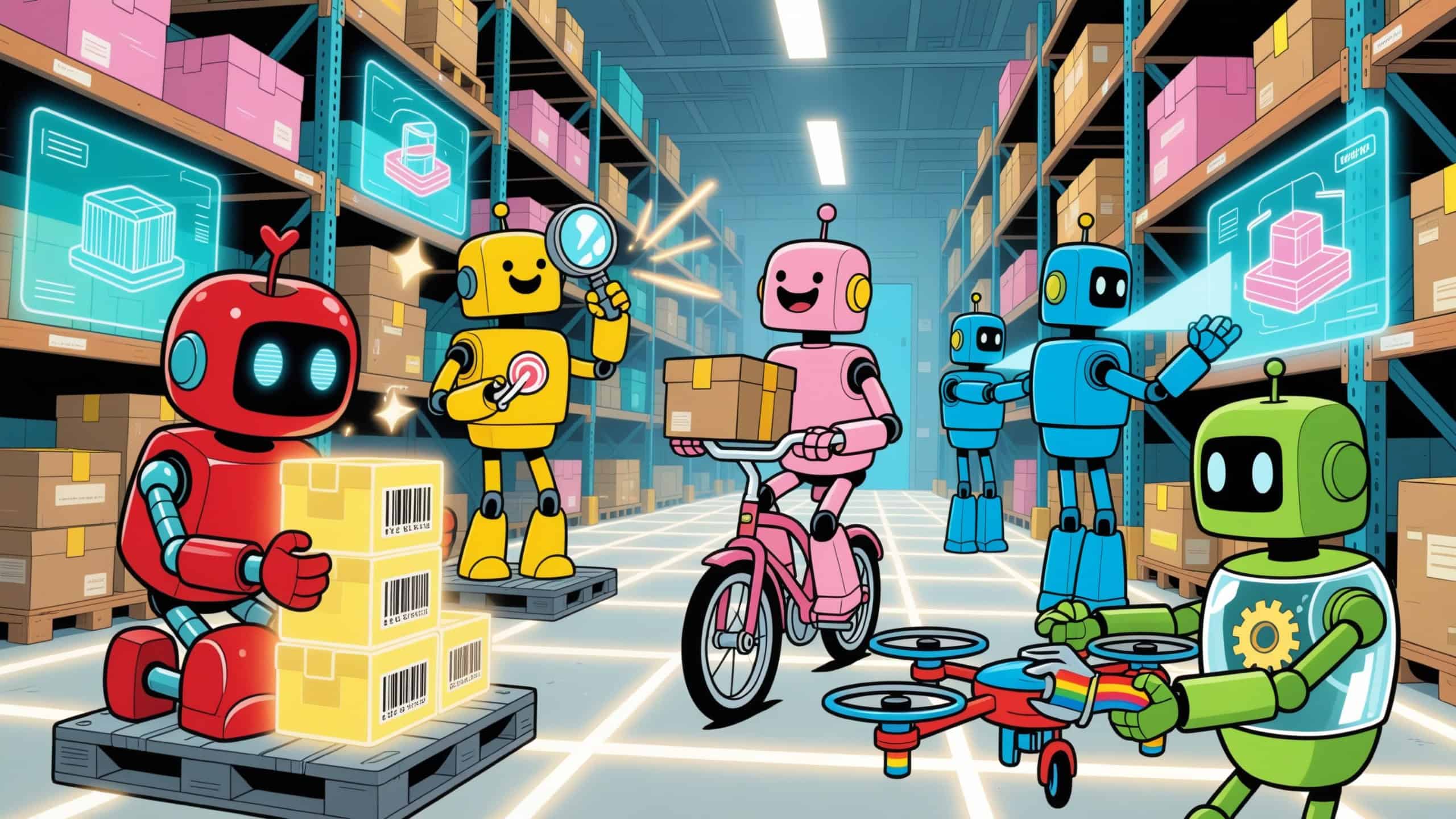
And this caught my attention: According to that New York Times report, the leaked documents included language guidance recommending staff avoid saying “automation” or “AI” when discussing robotics initiatives. Instead: use “advanced technology” or “cobot“—collaborative robot.
The same documents reportedly projected that Amazon could avoid hiring more than 600,000 U.S. workers by 2033.
Cobot kept looping in my head.
The word sounds almost gentle—a partner working alongside you (thinking of after-work drinks here too). Technically accurate, too—these robots do work with humans. They’re collaborative for now.
What got me was the juxtaposition. According to the Times, the documents that recommended softer terminology also contained projections for positions that wouldn’t need to be filled.
Morgan Stanley analysts estimated the automation could generate $2 to $4 billion in annual savings by 2027—roughly 30 cents saved per item processed.
Reports indicate Amazon plans to roll out the Shreveport, Louisiana warehouse model to approximately 40 facilities by 2027—a design that reduced staffing needs by about 25% compared to traditional warehouses.
According to the documents, the robotics team’s long-term goal is to automate 75% of operations.
So yes, it may sound like a partnership. But the math, though—the math is about scaling without people.
Well, this framing isn’t unique to Amazon. Every company does this, for good reasons. They have to. You can’t announce “we’re eliminating 600,000 future positions” without padding it in language about productivity and collaboration.
Public messaging focuses on augmentation. Internal spreadsheets track which roles get automated and when.
Elon Musk skipped the padding entirely. (Why am I not surprised?)
On Tesla’s October earnings call, he told shareholders he needs a $1 trillion compensation package to keep control over—and I’m quoting him here—the “robot army” Tesla is building.
Robot army.
Not collaborative robots. Not AI assistants. Robot army.
I actually laughed reading the transcript. Amazon hired linguistics consultants. Workshopped euphemisms. Tested messaging with focus groups, probably. Musk just said “robot army” on an investor call and kept going.
Different communication strategies. Same underlying math. Both companies are planning for more output with fewer humans.
Then there’s China. According to October 2025 reports, Chinese robotics startup AgiBot announced a framework agreement to deploy nearly 1,000 humanoid robots in Longcheer Electronics’ factories.
Not a pilot program. Not a proof of concept. Production work. Manufacturing at scale. Already happening.
Three companies. Three approaches to talking about it. One pattern underneath all of them.
We’re debating whether AI and robotic automation should happen or is good at all. They’re scheduling how much and when.
Still with me? Good. Because this is where it gets interesting.
The AI Learning Guy newsletter 🤖 🧠💡
AI learning hacks and mega prompts delivered to your inbox.
When productivity becomes a reduction strategy
The companies aren’t lying about productivity gains.
When Amazon says robots help workers be more productive, that’s accurate. Workers do handle more volume. They make fewer errors. They move through tasks faster. The robots genuinely help.
Here’s where the math gets uncomfortable, though.
If one worker now produces what two workers used to produce, you need half as many workers for the same output—simple arithmetic. No conspiracy. Just a logical consequence of the productivity gain everyone celebrates.
Think of it like this: imagine you’re baking cookies. You used to bake one tray per hour. You get a fancy new oven that lets you bake three trays at a time. Great productivity win.
But if your cookie shop needs to produce ten trays a day, you now need fewer bakers on shift. The bakers you keep are more productive. The ones you don’t hire never show up in layoff statistics.
Salesforce followed this exact pattern. Cut customer support from 9,000 people to 5,000 after implementing what they called “agentic AI.” Their CEO framed it as capability expansion—they can now follow up on 100 million customer calls they couldn’t touch before. Better coverage. More touchpoints.
All true. The capability did expand.
The headcount, though? Dropped 44%.
IBM tried moving faster. Cut 8,000 positions. Replaced them with AI systems. Quality tanked. They quietly rehired people. That failure became everyone else’s lesson in pacing.
The refined playbook emerged from that stumble: keep existing workers. Stop hiring new ones. Let growth and natural attrition smooth the transition. No dramatic layoffs. No headlines. Just steady revenue growth with flat or declining headcount.
It works. Companies are now running this playbook across industries.
Duolingo offboarded 10% of its contractor translators, citing AI efficiency gains. Not technically layoffs since they were contractors. But the pattern holds.
While we debate future scenarios—“Will AI take jobs?”—companies write present-tense strategy documents. With specific numbers. Timelines. Cost projections. Exact dates when certain positions become redundant.
What keeps circling back for me: where does this leave people who want to do work that matters?
I don’t mean defensively. Not the “how do I keep my job from a robot” panic. More like… where do humans actually add value when machines can produce 1,000x more than we can?
The productivity gap is real and growing. A human writes one report. AI generates a thousand. A human codes one feature. AI ships ten. Faster. Often good enough. Sometimes better.
So what’s left?
What machines still can’t do (and why it matters more than you think)
Machines produce outputs at scale. Fast. Quality keeps improving.
What they can’t do is own the outcome.
Stay with me here because this distinction is everything.
A machine can write a comprehensive market analysis report. Clean formatting. Good data visualization. Solid recommendations based on pattern recognition.
What it can’t do is tell you that the real problem isn’t what the client asked you to analyze.
It can’t read a room and know that what someone says they want differs from what would actually help them.
It can’t sense when a technically correct answer would crater a relationship.
It can’t navigate the gap between stated problems and actual problems.
Execution is automatable. Judgment isn’t. At least not yet.
Look at who keeps their roles in these restructurings.
Amazon isn’t eliminating every warehouse position. They’re targeting repetitive output work—the predictable tasks that follow clear rules.
What stays: exception handling, judgment calls when systems conflict, coordination across teams when something breaks the pattern.
Salesforce didn’t eliminate all customer support either. They eliminated routine query positions. Complex cases remain human. The ones needing context. Empathy. Strategic problem-solving that considers relationship history and future implications.
The pattern holds everywhere. Output work gets automated. Work that connects outputs to outcomes stays human.
For decades, your value was simple. I produce X. I write code. I create designs. I analyze data. Your output defined your worth.
That’s inverted now.
If your value proposition lives in output—how many reports you write, how much code you ship, how many designs you create—you’re competing with systems that output faster and cheaper.
The economics tilt away from humans in that race. Hard to win a cost-per-unit contest with machines that don’t sleep.
If you own outcomes, though—ensuring the right problems get solved, building relationships that turn deliverables into impact, providing judgment that prevents expensive mistakes—the automation math shifts. Still complex to replace. Still worth paying humans for.
Value is migrating from what we make to what we enable.
Amazon’s documents don’t say “eliminate all workers.” They say “avoid hiring 600,000 workers while doubling sales.” So humans remain. Just fewer of them. The ones who own outcomes machines can’t touch.
This isn’t a prediction. It’s an observation about where economic value is already moving.
The companies figured this out. The strategies are documented. The leaked memos prove it—they’re keeping specific positions and not filling others. They’ve mapped exactly where humans justify the cost and where automation makes more sense.
What gets me is the gap between public conversation and internal planning. We’re still debating whether this should happen, having philosophical discussions about the ethics of automation and the future of work.
The spreadsheets show it’s happening now. Timelines. Headcount targets. Cost savings.
Companies are doing what’s economically rational. Can’t fault them for that, really. They’ve identified where humans add enough value to justify our salaries and where we don’t.
The question shifted while we were debating.
Used to be: “Will robots take jobs?”
Now: “What do I own that they can’t?”
What you produce or what you enable?
Your outputs or your outcomes?
I’m still working through what that means.
For me, it means I stopped defining my value by how many newsletters I write and started focusing on whether readers actually shift how they think about their work.
The output (newsletter) is increasingly automatable. The outcome (changing how someone approaches their career) isn’t.
For someone in customer support, it might mean moving from “I handle 50 tickets per day” to “I prevent escalations that would cost us customers.” Same work, different framing—but the framing determines which side of the automation line you’re on.
The leaked memo showed me where companies are headed. The numbers make it clear. The language attempts to soften it—hence “cobot”—but the math doesn’t care about framing.
Value is moving. Some people will move with it. Others won’t notice until the projections become their reality.
That’s what I keep working through. For myself. For the people I know who are building careers, for anyone trying to figure out how to do work that matters in systems that can generate outputs at scale.
The companies have their answer. Now we need ours.
Cheers,
Mark
The AI Learning Guy
👋⚡😎
The AI Learning Guy newsletter 🤖 🧠💡
AI learning hacks and mega prompts delivered to your inbox.
Interesting Sources
Amazon’s Leaked Automation Strategy: The New York Times Investigation
Musk’s $1 Trillion “Robot Army” Demand: Fortune Analysis
China’s 1,000-Robot Factory Deployment: China Daily Report
Salesforce Cuts Support Staff by 44%: Tech.co Coverage
Morgan Stanley on Amazon’s Automation Savings: Yahoo Finance
666,000 Tech Jobs Lost Since 2022: Medium Analysis
Goldman Sachs: 300 Million Jobs at Risk from AI: Goldman Sachs Insights
China’s Humanoid Robot Mass Production: South China Morning Post
MIT Study: Robots’ Impact on Jobs and Wages: MIT Sloan Research
World Economic Forum: 85 Million Jobs Displaced by 2025: AI Job Loss Statistics
Note: No single website has all the answers. This list serves as a starting point for those who want to explore or satisfy their curiosity about AI.
Links: Links with * are affiliate links. See disclosure below.