
Best Machine Learning Courses Online 2026
21 Machine learning online courses to become an engineer
Machine Learning (ML) is a branch of artificial intelligence (AI) that involves various methods of data analysis with the end goal of creating automatic analytical models. It refers to the science of equipping computers to perform complex functions with minimal human intervention, serving as the gateway to the innermost domains of Data Science.
The concepts and practices of machine learning are not restricted to Data Science and ML experts, per se. It can also bring advantages to experts from other domains.
The rising demand for ML professionals has coincided with the rise of MOOCs and Machine Learning certification programs. These opportunities allow professionals to transition into new domains, advance their careers, and stay at the forefront of the field.
Below, we give you a tour of the best machine learning courses online, including career paths, certifications, and master’s.
Overview
Bill Gates stated that Artificial Intelligence, energy, and bioscience are among the most promising careers for today’s graduates. Many believe merging AI with energy can solve pressing issues in production, sustainability, distribution, transportation, and overall quality of life.
This growing emphasis on future-oriented fields has fueled a strong interest in Machine Learning—viewed as the key to unlocking valuable corporate and consumer data for informed decision-making. At its core, Machine Learning revolves around algorithms and tasks broadly categorized into Supervised, Unsupervised, and Reinforcement learning.
Mastering these techniques often requires self-study, especially for professionals transitioning into ML from other disciplines. For those seeking to strengthen their career prospects through education, exploring reputable online Machine Learning courses can provide the knowledge and skills needed to stay competitive in this evolving domain.
Best Machine Learning Courses Online 2026
| ML on Udacity | ML on GetSmarter | ML on Coursera | ML on Udemy |
|---|---|---|---|
 |  |  |  |
| Nanodegrees | Certified Courses | Specialications | Courses |
| from $249/month | from $1,900 | from$59/month | from $11.99 |
| View Courses | View Courses | View Courses | View Courses |
*Disclaimer: This post contains affiliate links. Read the full disclosure at the end of this post.
The following list of best machine learning courses, specializations, and certifications caters to aspiring ML professionals of varying skill sets. You can compare your own needs against these to determine a curated program that is most suitable for you.
1. AWS Machine Learning Engineer – Udacity
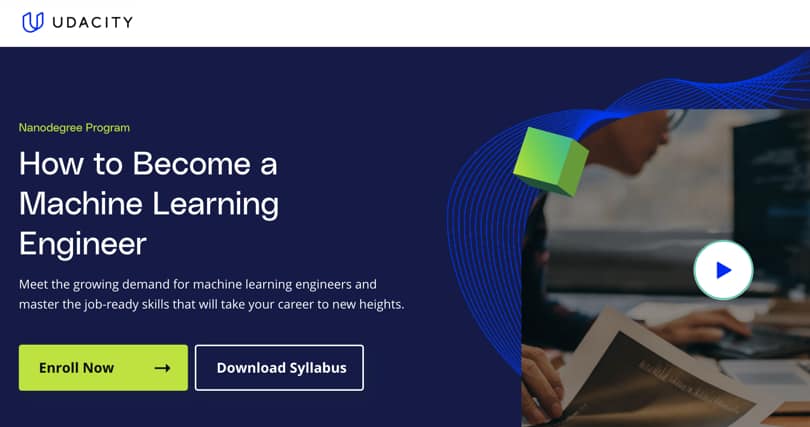
If you’re comfortable with Python and ML fundamentals but need production skills, Udacity’s AWS Machine Learning nanodegree (visit website) addresses that gap directly. This program focuses less on theory. It prioritizes the engineering reality of deploying models to scalable cloud infrastructure, aligning with what hiring managers expect today.
The curriculum centers on Amazon SageMaker as your deployment platform. You’ll progress through four hands-on projects mirroring real production scenarios. Start with AutoGluon for automated model training. Then build complete ML workflows using Lambda and Step Functions.
Later projects tackle image classification and operationalization challenges. Cost optimization and security configurations become your focus—concerns that dominate production environments.
What sets this course apart as one of the best machine learning courses online is its industry backing. AWS, Kaggle, and practitioners from Intel and SOCi shaped the curriculum. The capstone involves building an inventory monitoring system for distribution centers. You’ll synthesize SageMaker deployment, automated workflows, and computer vision techniques.
Instructors: Bradford Tuckfield, Matt Maybeno, others | Certificate: Yes
Prerequisites: Intermediate Python, ML Algorithms
Info: View Course on Udacity. From $249/month. Try with a discount.
2. Machine Learning, Andrew Ng – Coursera
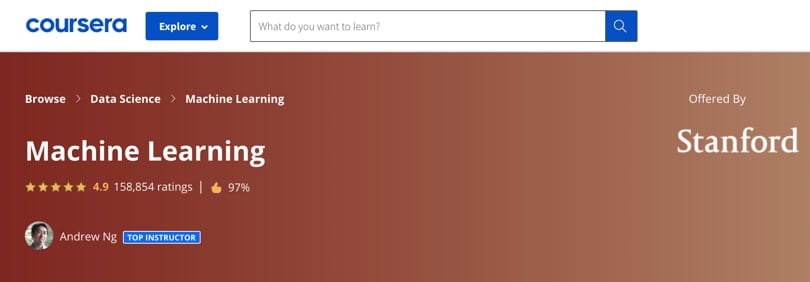
There’s a reason a million learners have taken Andrew Ng’s Machine Learning course (visit website) on Coursera. His teaching approach makes abstract algorithms feel intuitive. This updated specialization reflects what made the original legendary—then modernizes it for Python and TensorFlow.
The three-course structure follows a visual-first pedagogy. Ng explains concepts through diagrams and animations before showing code. Mathematical theory comes last, marked as optional. You grasp why gradient descent works before implementing it. That sequencing reduces the overwhelm that beginners face with machine learning online.
Course one covers supervised learning foundations. Linear regression and logistic regression in NumPy and scikit-learn. You’ll understand cost functions, regularization, and feature engineering through practical implementation.
Neural networks arrive in course two via TensorFlow. Ng walks you through activation functions and backpropagation visually. Decision trees and ensemble methods, such as XGBoost, follow. He explains when to choose neural networks over tree-based models. This practical guidance is rare in theory-heavy courses.
The final course tackles unsupervised learning, recommender systems, and reinforcement learning. You’ll build a lunar lander using deep Q-learning. The specialization wraps modern best practices around foundational algorithms, making it among the best machine learning courses online for beginners.
Instructor: Stanford Online, Andrew Ng | Platform: Coursera
Duration: 2 months, 60 hours. | Rating: 4.9/5 ★★★★★
Info: View Course. Browse: Search all machine learning courses on Coursera.
3. Become a Machine Learning Engineer for Microsoft Azure – Udacity
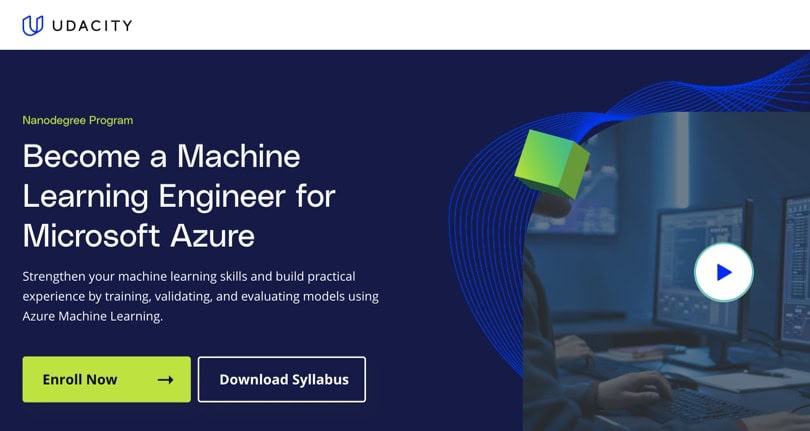
Most online machine learning courses teach you how to build models. The Machine Learning Engineer for Microsoft Azure nanodegree (visit website) teaches you how to choose between competing approaches. That distinction matters in enterprise environments where resource costs and maintainability drive decisions.
The curriculum revolves around comparing three deployment methodologies on Azure. You’ll build the same solution using custom scikit-learn pipelines with Hyperdrive. Then rebuild it using AutoML. Finally, document the trade-offs—computational cost, accuracy, interpretability, and development time.
Your opening project forces this comparison explicitly. You’ll import data via Azure ML SDK and configure Hyperdrive for hyperparameter optimization. Running AutoML on identical data comes next. The deliverable isn’t just working models but a justified methodology selection—the kind of documentation stakeholders actually need.
The second project then shifts to MLOps fundamentals. You’ll deploy an AutoML model to production and enable Application Insights for monitoring. Parsing logs to identify performance issues becomes routine. Azure Pipelines handle orchestration, mirroring DevOps practices that dominate enterprise ML workflows.
The capstone synthesizes everything using external datasets you select. Deploying your best-performing model as a web service wraps up the experience. The program also prepares you for Microsoft’s DP-100 certification—a valuable credential validation for Azure-centric organizations.
Instructors: Noah Gift, Alfredo Deza, Erick Galinkin | Certificate: Yes
Prerequisites: Intermediate Python, ML, Statistics
Info: View Course on Udacity. From $249/month. Try with a discount.
4. Mathematics of Machine Learning Specialization – Imperial College London, Coursera

Linear algebra feels abstract until you see it power PageRank. Calculus may seem theoretical, but its practical applications become evident when gradient descent optimizes your neural network. Imperial College’s specialization (visit website) connects these mathematical concepts directly to its ML applications.
The three-course structure rebuilds the foundations you may have studied but struggled to connect with computer science. You’ll begin with linear algebra—understanding how vectors and matrices relate to data operations. Your first assignment implements PageRank for a simulated web, showing how matrix operations underpin Google’s search algorithm.
The second course introduces multivariate calculus through optimization problems. You’ll learn how partial derivatives help fit functions to data, then see these principles at work in neural network training. Backpropagation becomes less mysterious once you grasp the underlying calculus. Instructors prioritize intuitive understanding over formal proofs throughout.
Principal Component Analysis becomes the capstone, synthesizing everything you’ve learned. Rather than treating PCA as a black box, you’ll derive it from geometric principles. The MNIST digits project then applies this dimensionality reduction to real image compression challenges.
Python notebooks accompany each module with interactive exercises. You’ll experiment with mathematical properties before implementing complete algorithms. This specialization clarifies the mathematical machinery that advanced courses assume you already understand, positioning it as valuable preparation among online machine learning courses.
Provider: Imperial College London, Coursera | Certification: From $59/month
Duration: 4 months. | Level: Beginners | Rating: 4.6/5 ★★★★★
Info: View Course. Browse: Search all ML courses on Coursera.
5. Machine Learning A-Z: Hands-On – Udemy
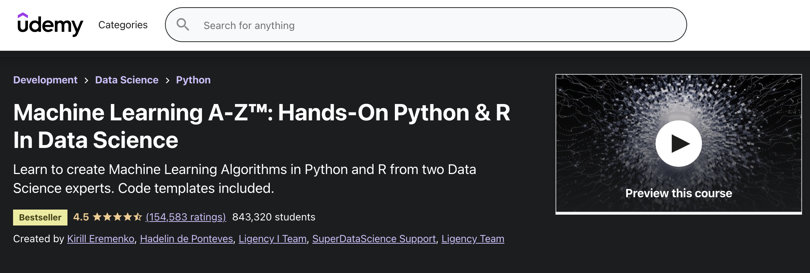
Udemy’s bestselling Machine Learning A-Z course (visit website) takes an unusual approach. Rather than choosing Python or R, you learn both. Kirill Eremenko and Hadelin de Ponteves teach identical algorithms in parallel implementations. This dual-language strategy clarifies which aspects are universal versus language-specific.
The 44-hour curriculum follows an alphabetical structure through ML techniques. Data preprocessing establishes workflows you’ll reuse throughout. Regression models come next—linear, polynomial, support vector, decision tree, and random forest variations. Each implementation includes downloadable code templates.
Classification algorithms follow the same pattern. Logistic regression, k-NN, SVM, kernel methods, Naive Bayes, and tree-based classifiers. You’ll understand when each performs best. Clustering and association rule learning address unsupervised scenarios.
Advanced sections cover dimensionality reduction, reinforcement learning, NLP, and deep learning fundamentals. The instructors prioritize intuitive explanations over mathematical proofs. Eremenko’s background at Deloitte Australia shapes his teaching style—practical implementation over academic theory.
Over one million students have completed this course. Udemy’s frequent discounts make it among the most affordable machine learning courses online. Code templates accelerate your projects after completion. The dual-language approach benefits data scientists working across different team preferences.
Instructor: Hadelin de Ponteves, Kirill Eremenko | Level: Beginners
Platform: Udemy | Video: 45 hours | User Rating: 4.5/5 ★★★★☆
Info: View course. From $14.99. Up to 95% off. Browse all machine learning courses.
6. Machine Learning – University of Washington, Coursera
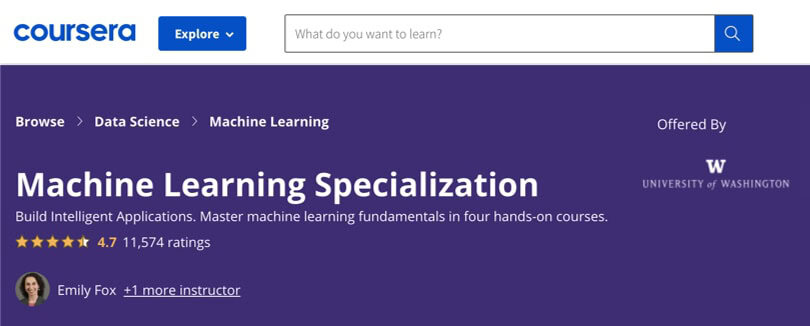
Taught by the University of Washington, Machine Learning (visit the website) is an in-depth specialization designed for learners with an intermediate-level skill set. Spanning over four hands-on online machine learning courses, the specialization will walk you through the essentials of ML: linear regression, classification, clustering, and retrieval.
Learners will begin with a foundational introduction to ML using a series of case studies. Some of these include estimating house prices, analyzing sentiments from user ratings, recommending products, retrieving documents, and other implementable areas.
From here, you will move on to applying linear regression to create predictive models and learn how to handle large sets of features and perform analysis. Your final milestone would be to use similarity-based algorithms for information retrieval and recommendations.
To do this, learners will have to master essential ML tools and techniques, such as clustering documents using k-means, expectation-maximization (EM), latent Dirichlet Allocation (LDA), etc. One of the best machine learning courses on Coursera.
Provider: University of Washington | Duration: 7 months. 3 hours/week
Level: Intermediate | Certificate: Yes
Info: View Course. Browse: Search all machine learning courses on Coursera.
7. Machine Learning in Business – MIT Sloan, GetSmarter
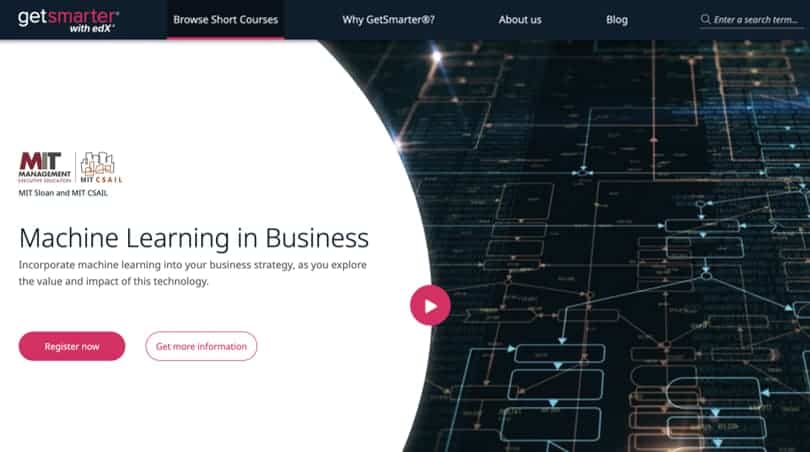
The MIT Sloan School of Management (visit website) offers a 6-week program for mid-to-senior-level managers tasked with enabling their workforce to gain a comprehensive understanding of using machine learning for problem-solving within a business environment and industry.
This course aims to provide learners with an operational perspective of ML and its practical functions in business. Moreover, data-centric professionals and business executives can also enroll in the course to derive massive benefits in the ML space.
Learners will begin with an overview of problem-solving with machine learning in business before diving into the ethics involved. Next, they will move on to more technical concepts involving model evaluations, neural networks for business, and model production.
During the program, participants will gain an understanding of the technical elements of ML and learn how to leverage the technology without needing to code or program. You will complete this certification with a module on justifying your organizational ML approach.
The skills gained in this class will help learners build and lead high-performance teams and ensure sound ML strategies that can be convincingly conveyed to stakeholders. One of the best machine learning courses online for business professionals.
Provider: MIT Sloan, GetSmarter | Duration: 6 weeks | Certificate: Yes.
Level: Professionals | Price: $3,850.
Info: Visit course website. Get free prospectus. Browse all ML courses on GetSmarter.
8. Intro to Machine Learning with PyTorch – Udacity
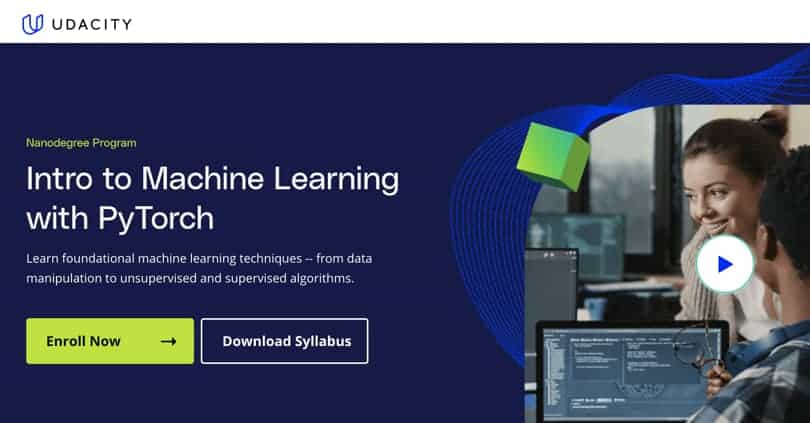
Many courses assume you already understand when to apply which algorithm. The Machine Learning with PyTorch nanodegree (visit website) takes a different approach. It guides you through the foundational decision-making process that distinguishes competent practitioners from those who merely manage library operations.
The curriculum follows a deliberate progression across three learning paradigms. You’ll start with supervised learning using scikit-learn. Here, you’ll evaluate algorithms such as Random Forest and Support Vector Machines to predict donor behavior for CharityML. The focus is on understanding algorithm selection, not just implementation.
Deep learning comes next with PyTorch as your framework. You’ll build an image classifier from scratch using neural networks. Training on the CIFAR-10 dataset teaches you how to design architectures, tune hyperparameters, and evaluate model performance. This project demands more effort than the first—expect to spend considerable time debugging training loops.
The final project shifts to unsupervised territory. You’ll apply K-means clustering and PCA to segment customer demographics for a German mail-order company. Data preprocessing and visualization dominate here. Understanding when clustering reveals actionable insights matters more than perfect accuracy metrics.
PyTorch’s flexibility makes this among the better machine learning courses for hands-on learners who prefer coding over theory.
Instructors: Cezanne Camacho, Mat Leonard, Luis Serrano | Certificate: Yes
Prerequisites: Intermediate Python
Price: View Course. From $249/month. Try with a discount.
9. Machine Learning DevOps Engineer – Udacity

In contrast to most other courses here, this Udacity nanodegree (visit website) prioritizes operational excellence in ML-driven systems. You’ll gain a deep understanding of code standards, modular design, and comprehensive testing tailored to models, not just conventional software.
The curriculum teaches reproducible ML workflows via MLflow and Weights & Biases, emphasizing dataset versioning and automated data quality checks. Assignments include building rental price prediction pipelines that accommodate ongoing data refreshes and enable robust, hands-off deployment.
Tools like Data Version Control, FastAPI, and Heroku cover everything from model lineage to serving infrastructure. The course is ideal for intermediate to advanced Python developers looking to transform fragile research code into scalable, maintainable ML operations, ensuring models succeed in production, not just in theory.
Instructors: | Certificate: Yes
Prerequisites: Intermediate Python
Price: View Course. From $249/month. Try with a discount.
10. Professional Certificate in Machine Learning + AI, Imperial College Business School, Emeritus
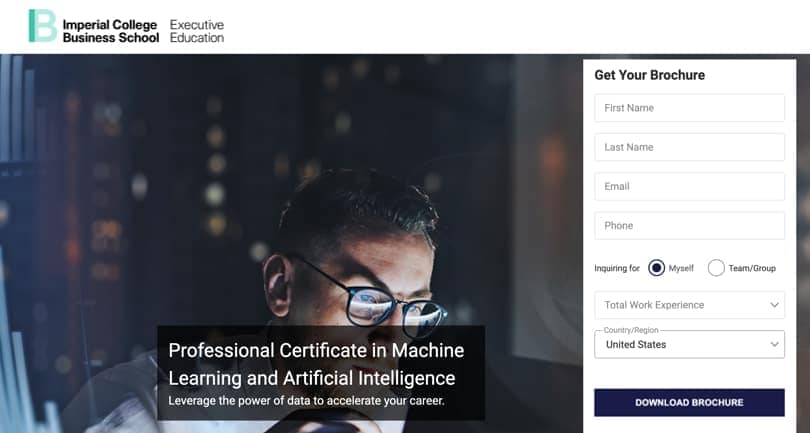
Imperial College’s certificate strikes a balance between technical depth and business application. The program design reflects a specific philosophy: understanding ML algorithms matters less without knowing when to deploy them. This distinguishes it from purely technical tracks.
The 25-week curriculum is divided into three phases. Foundations cover ML and AI fundamentals. Methods introduce decision trees, regression techniques, and probabilistic models. Advanced topics then address deep learning, neural networks, and generative AI principles.
Faculty from Imperial’s Department of Computing and Business School co-teach the program. Wolfram Wiesemann and Ruth Misener bring computational expertise. Christopher Tucci contributes digital strategy perspectives. This interdisciplinary approach runs throughout the curriculum.
A capstone project accompanies the modules. You’ll work on parameter tuning and model refinement—skills that translate directly to workplace applications. Faculty introduce ML competition frameworks, offering pathways beyond course completion.
Python serves as the implementation language. Hands-on activities reinforce lecture concepts. Career services include resume feedback and mock interviews through Emeritus. Upon completion, you receive Associate Alumni status from Imperial College Business School, positioning this among comprehensive machine learning courses for professionals seeking credential validation.
Provider: Imperial College, Emeritus | Time: 25 weeks | Certificate: Yes.
Level: IT + Data Professionals | Pace: Instructor-lead | Price: $4,480 or £3,995.
Info: Visit course website. Get free brochure. Browse full course catalog on Emeritus.
11. IBM AI Engineering, Professional Certificate – Coursera
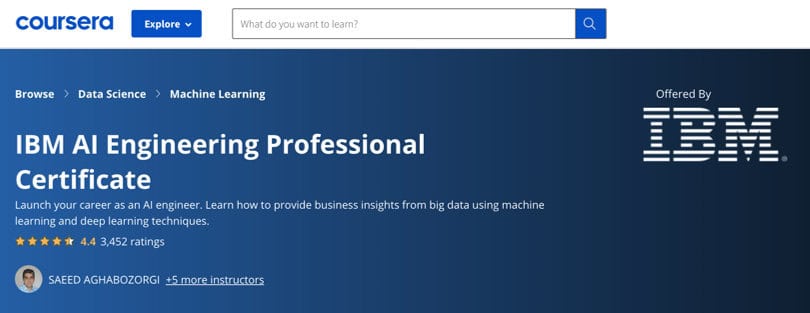
IBM’s AI Engineering Professional Certificate (visit website) prioritizes skills that enterprises actually need. The curriculum emphasizes scalability and production deployment using frameworks that companies rely on and actually use.
The six-course structure begins with machine learning fundamentals in Python. Regression, classification, and clustering using scikit-learn. Standard territory, but then Apache Spark enters the picture. You’ll learn to scale algorithms on big data—the kind that overwhelms single machines. Companies like NASA and Amazon rely on these techniques.
Deep learning follows across three frameworks. Keras introduces neural network architectures quickly. PyTorch provides flexibility for custom implementations. TensorFlow handles production deployment at scale. Learning all three gives you adaptability, as companies use different stacks.
Projects focus on computer vision and NLP applications. You’ll build convolutional networks for image recognition. Recurrent networks for text analysis. Recommender systems using collaborative filtering. Each project simulates industry scenarios rather than toy datasets.
The capstone synthesizes everything. Compare Keras and PyTorch implementations. Evaluate performance metrics. Deploy your best model. IBM issues a digital badge upon completion, which hiring managers recognize. This certificate ranks among the best online machine learning courses for professionals targeting AI engineering roles.
Provider: IBM, Coursera | Duration: 8 months. 3 hours/week. | Certificate: Yes
Info: View Course. Coursera Plus – $59/month. View.
12. AI Machine Learning Engineering Career Track – Springboard
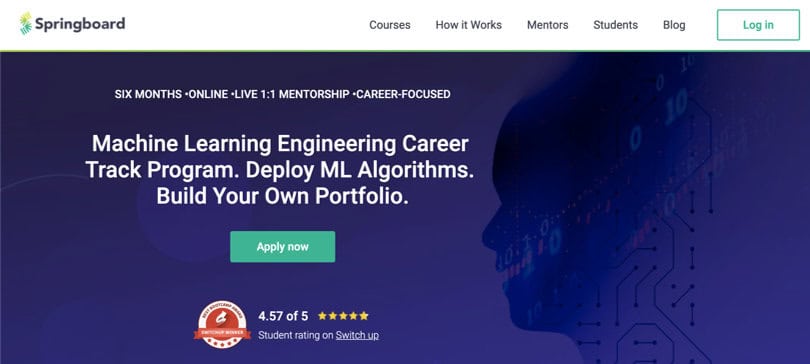
Springboard’s career track prioritizes outcomes over content. The curriculum matters, but the real differentiator is accountability. Land a qualifying job within six months of completion or receive a full tuition refund. This guarantee shapes everything about the program.
The 400-hour curriculum dedicates over 100 hours to capstone projects. You’ll build and deploy complete ML systems—not demos. One capstone project involves designing a complete machine learning pipeline, from prototype to production deployment, via API or web service. This deliverable becomes portfolio material for interviews.
Weekly one-on-one mentorship comes from professionals at Google, Facebook, and Airbnb. These 30-minute video calls provide code reviews, career guidance, and interview preparation. Mentors remain available via email between sessions. This isn’t automated feedback—it’s direct access to working engineers.
Career coaching runs parallel to technical learning. Mock interviews. Resume reviews. Job search strategy. The career team guides you through networking and applications after graduation. Their support continues until you accept an offer.
Prerequisites reflect the target audience. Springboard expects at least one year of professional software engineering or data science experience. The program transforms existing technical skills into specialized ML engineering capabilities, making it one of the best machine learning courses for career switchers with coding backgrounds.
Provider: Springboard | Duration: 6 months | Certificate: Yes.
Info: Hands-on experience. Career support.
1:1 Mentoring: Yes | Job Guarantee: Yes
13. Machine Learning: From Data To Decisions – MIT
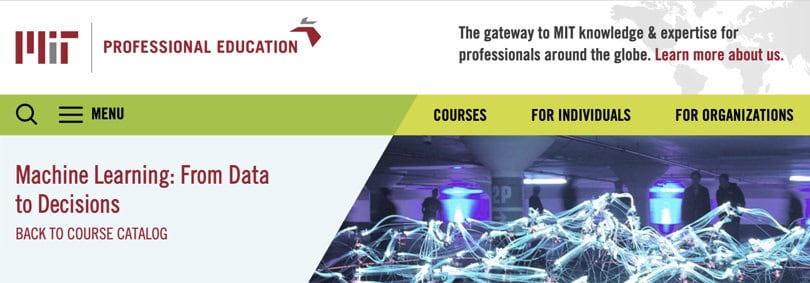
MIT’s offering stands out from other machine learning courses online by targeting decision-makers rather than programmers. Designed for CTOs and executives, the eight-week curriculum focuses on strategic evaluation over technical implementation. You’ll learn to assess data quality and manage budgets wisely, translating model outputs into actionable business strategies.
Since the course is designed to help students with ML implementation, key areas of focus include ML algorithms that help with predictive analysis, a foundational understanding of ML applications that drive critical decision-making, and causal inferences to analyze the impact of essential variables.
As a student, you earn 6.4 continuing education units while gaining the insight needed to steer ML adoption for measurable business advantage. If your role involves guiding technical investments, this program validates your ability to align machine learning initiatives with organizational goals. Common industries include manufacturing, IT services, retail, media, finance, Business Intelligence, and healthcare.
Duration: 8 weeks | CEUs: 6.4 CEUs | Certificate: Yes. | Price: $2,300.
Tip: If you have a different career focus on AI, explore the best artificial intelligence courses or deep learning courses.
14. AWS Certified Machine Learning Engineer Associate
Unlike most machine learning courses online, this AWS certification stands out by focusing on the realities of deploying models in production, not just theory. You’re challenged to make real architectural choices: choosing between Glue and DataBrew for data prep, leveraging SageMaker for hyperparameter tuning, and automating CI/CD pipelines using Step Functions and Lambda.
The exam’s emphasis isn’t on trivia—it’s on decisions that impact system scalability and resilience. Monitoring topics, ranging from CloudWatch metrics to Model Monitor dashboards, reflect the practical skills required to distinguish between real data drift and routine variance.
Priced at $150 for 65 questions in 170 minutes, the test validates at least a year’s hands-on SageMaker experience. If you’re a DevOps engineer or backend developer aiming to master production machine learning systems, earning this credential demonstrates that you bridge the gap between experimentation and robust, reliable deployments.
Provider: AWS Amazon | Duration: 2.5 hours. 65 questions | Certificate: Yes.
Registration fee: Yes. | Prerequisites: None
Info: Visit website.
15. Google Cloud Professional ML Engineer
This credential focuses on integrating tools within Google Cloud, reflecting the actual workflow of machine learning engineers. Rather than navigating disjointed systems, you’ll be evaluated on deploying models efficiently using Vertex AI and handling feature engineering in BigQuery ML. The course blends expertise in traditional and generative AI, emphasizing both development and deployment.
Tasks such as configuring CI/CD for retraining, implementing preemptive monitoring, and automating workflows showcase the operational side of machine learning courses online. Special attention goes to Responsible AI, including bias detection and model explainability, which are critical as regulatory oversight grows.
With a two-hour exam and a recommendation of three years’ experience, this program confirms your ability to balance innovation with operational stability—skills vital for leadership roles in machine learning.
Provider: Google | Duration: 2 hours. 50-60 questions | Certificate: Yes.
Registration fee: Yes. | Prerequisites: None
Info: Visit website.
16. TensorFlow Developer Professional Certificate – Google/Coursera
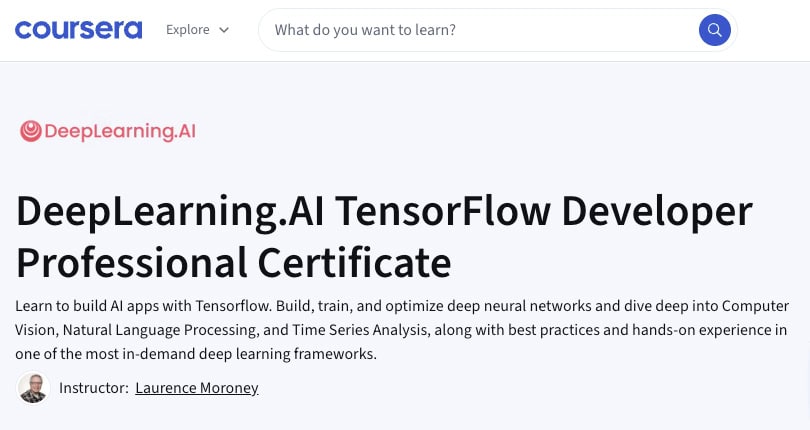
Many machine learning courses online overlook the practical realities of model deployment, but this four-course certificate (visit website) immediately tackles production challenges in TensorFlow. Under Laurence Moroney’s guidance, you’ll master neural networks through the Sequential API and explore computer vision using transfer learning to maximize data efficiency.
Natural language processing projects—ranging from sentiment analysis to conversational AI—foster practical experience with embeddings, RNNs, LSTMs, and transformers via HuggingFace. Real-world skills are tested with a time-series project using sunspot data.
Completing the program prepares you for Google’s TensorFlow Certificate exam, signaling readiness for ML engineering roles. With just Python basics and high school math, transitioning from software development to machine learning becomes attainable and career-boosting.
Provider: DeepLearning.AI, Coursera | Duration: 2 months. 10 hours/week
Level: Intermediate | Certificate: Yes
Info: View Course. Browse: Search all ML courses on Coursera.
17. Machine Learning in Production – Coursera
A common challenge graduates face from online machine learning courses is moving from high-accuracy models in notebooks to functioning production systems. ML in Production (visit website), led by Andrew Ng, bridges that gap. It encourages strategic planning before jumping into code, focusing on project scoping and differentiating best practices for both small and large datasets.
You’ll build robust data pipelines with TensorFlow Extended, ensuring validation is part of the process—not an afterthought. Instruction covers feature engineering with tf.Transform and fairness analysis, equipping you to spot model biases early.
The curriculum emphasizes practical deployment techniques, including TensorFlow Serving and progressive model delivery. With Google engineers as co-instructors, the course prepares you to convert research prototypes into scalable, maintainable ML solutions—setting you apart in real-world MLOps roles.
Provider: DeepLearning.AI, Coursera | Duration: 1 week. 3 hours/week
Level: Intermediate | Certificate: Yes
Info: View Course. Browse: Search all machine learning courses on Coursera.
Provider: MIT | Duration: 6 months | Certificate: Yes.
Choosing the Best Machine Learning Courses Online
Machine Learning is increasingly becoming a democratized field, calling for a similar learning approach. The universal availability of MOOCs and paid certifications has made learning more accessible for aspiring ML professionals.
The catch will be to opt for the best machine learning courses online that match one’s skillset. Performing comparative research on these popular online machine learning courses will go a long way in helping you make the right choice.
As stated earlier, online machine learning courses are not only for AI professionals but can benefit people from other domains. Anyone remotely connected to the field or aiming for higher productivity can benefit from these.
However, you wouldn’t want to waste your energy on courses that are not relevant to your domain. For this reason, it’s recommended to thoroughly consider the following.
Current Skillset – ML will require coding and working with Statistics, Calculus, and linear algebra at a minimum. If you are not confident, we recommend practicing these on the side.
Future Goals – Are you an ML professional looking to advance your career, switch roles, or simply curious about the future? Your choice of the best machine learning courses will depend on your current professional status.
Financial Circumstances – Although some online machine learning courses listed above offer financial aid, many do not. Consider both your range and the course outcome before deciding to invest in one.
Once you’ve thoroughly assessed the criteria mentioned above as well as performed a comparative study of the best machine learning courses online, you will automatically be drawn to the program that aligns the best with your current and future needs.
Best Machine Learning Courses Online 2026 – Verdict
Investing your time and energy in a self-paced, curated course requires both motivation and a strong commitment. ML might have become very democratized, but it is also very intensive.
Choosing an appropriate online machine learning course is all the more critical. Whatever your end goal, so long as you manage to inflate your skillset in machine learning and artificial intelligence through enrolment, it is a win-win.
Best Machine Learning Courses Online 2026
- AWS Machine Learning Engineer – Udacity
- Machine Learning, Andrew Ng – Coursera
- Become a Machine Learning Engineer for Microsoft Azure
- Mathematics of Machine Learning Specialization – Imperial College London
- Machine Learning A-Z: Hands-On – Udemy
- Machine Learning – University of Washington
- Machine Learning in Business – MIT Sloan, GetSmarter
- Intro to Machine Learning with PyTorch – Udacity
- Machine Learning DevOps Engineer – Udacity
- Professional Certificate in Machine Learning + AI, Imperial College Business School
- IBM AI Engineering, Professional Certificate – Coursera
- AI Machine Learning Engineering Career Track – Springboard
- Machine Learning: From Data To Decisions – MIT
- AWS Certified Machine Learning Engineer Associate
- Google Cloud Professional ML Engineer
- TensorFlow Developer Professional Certificate – Google/Coursera
- Machine Learning in Production – Coursera
What are the best machine learning courses online? Have you taken any of the ML courses above? What is your learning experience? Let us know in the comments below.
Sources: What is data science? | What is machine learning? – Wikipedia | What is scipy? – 2 | What is AI? – IBM | Programming languages for ML – 4 | Self-Driving Cars – 5 | Matrix Factorization – 6 | What is K-means clustering? – 7 | What is Random Forest? – 8
Disclosure: Some of the links on this site are affiliate links, which means AI Learning Guy may earn a commission if you make a purchase through them, at no extra cost to you. Your support through these links helps me maintain and improve the site, so I can keep sharing high-quality, helpful content with readers like you. All reviews, opinions, and comparisons are written independently and reflect my honest perspective.