
#67 | The AI we always imagined
TL;DR: Yann LeCun, the AI pioneer behind ChatGPT’s core ideas, just raised $1B to prove the whole LLM revolution is wrong, a dead end—and wants to build something smarter.
👋 Hello,
You already know what real AI looks like. You’ve known for a long time.
For example, it understands a room. A glass or heavy object near the table’s edge is a potential problem that you or your 1-year-old child sees before you.
Walk through a door, and it reads your posture. Hand it something fragile, and it adjusts. Something is about to go wrong — and it already knows.
It’s WALL-E, sorting trash by weight and fragility. HAL 9000 is certain of what happens if that pod bay door opens. Samantha in Her, who grasps not just what you say but what you mean.
None of that is ChatGPT. Maybe never will.
That’s certainly not meant to be criticism. ChatGPT is extraordinary at what it does. But what it does, at its core, is complete language.
It has absorbed more text than any human could read in a thousand lifetimes. It explains, translates, summarizes, and argues. At eleven at night, it writes a decent cover letter. At 3 am, it gives you live advice without sounding drunk. Maybe a b bit hallucinated, ok.
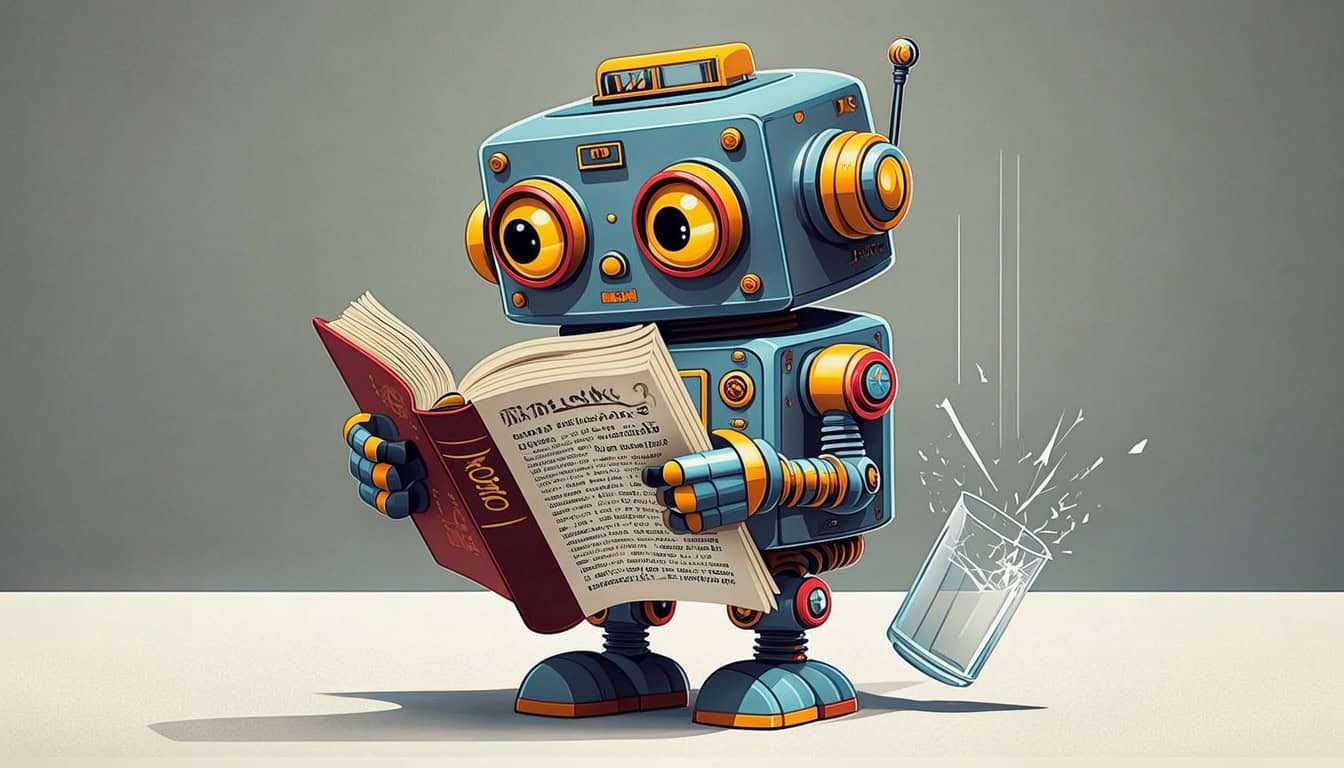
Push a glass off a table and ask it what happens.
It knows the words. “Glass,” “fall,” “break,” “floor.” It has read ten million descriptions of things shattering.
Yet it doesn’t have any felt sense of falling. Not the way you do without thinking. Not the way a five-year-old does before anyone taught them physics.
That knowledge lives somewhere language doesn’t fully reach.
And that limitation is what today’s edition is about: whether LLMs are just a flash in the pan that will be replaced. And by what?
The AI Learning Guy newsletter 🤖 🧠💡
AI learning hacks and mega prompts delivered to your inbox.
What LeCun kept saying about AI
Yann LeCun is not a commentator. He is one of the architects of modern AI.
In the 1980s, he helped develop convolutional neural networks and backpropagation. Every large AI model running today is built on those techniques — ChatGPT, Claude, Gemini.
In 2018, he shared the Turing Award with Geoffrey Hinton and Yoshua Bengio. The Turing Award is the Nobel Prize of computer science. He spent the next twelve years leading Meta’s AI Research division.
The whole time, he kept saying the same thing.
Language models predict language.
That is not the same as understanding the world.
Gary Marcus, a cognitive scientist at NYU, illustrated why. An LLM trained on millions of chess games will still move (virtually) a queen through another piece. We know that’s physically impossible.
It learned the vocabulary of chess. It never learned chess.
Once you see the distinction, it turns up everywhere.
An LLM knows what humans have written about how things behave. It has no internal sense of how things actually are.
Last November, LeCun left Meta. He reportedly told Zuckerberg he could build something better on his own.
Then, from Paris — chosen specifically because Silicon Valley is, in his words, “LLM-pilled” — he announced Advanced Machine Intelligence, or AMI.
$1.03 billion in seed funding. The largest seed round in European history. No product. No revenue. No commercial timeline. Maybe Europe finally gets it right, or loves a gamble.
What LeCun is building in Paris
The technical name for AMI’s approach is JEPA — Joint Embedding Predictive Architecture. But the name matters less than the idea.
An LLM reads words and predicts what comes next. It works entirely in language-space. JEPA tries to predict the next state of the world.
Not predicting patterns found in text. Patterns found in reality. What follows from what, and how things behave when you touch them.
LeCun calls the goal “an abstract digital twin of reality.”
It is an internal model that an AI uses to predict consequences and plan actions. Something that reasons about situations it has never explicitly encountered.
Consider folding laundry. Shirts twist. Fabric weight shifts. Textures catch differently depending on the weave. How would you approach the topic?
Training a robot on descriptions of how to fold laundry helps almost nothing.
But training it on a world model — a felt sense of how fabric moves and hands grip — gets you something that can handle Tuesday morning.
AMI’s first announced partner is Nabla, a healthcare AI company. That choice is telling.
There is a real difference between matching symptom descriptions and modeling how a body works. One finds patterns in medical language. The other understands physiology.
But what’s LeCun’s own timeline here?
One to two years to begin with corporate partners. Three to five years for something broadly useful. (That’s a long time for LLMs to survive and drive.)
So, AMI has only published a theory so far. Forget about benchmarks here. Nothing.
Historically, this is where many elegant architectures go quiet, and maybe AMI is the flash in the pan.
The part where we don’t know things
Some researchers have pushed back indeed. Language, as humans use it, already encodes physical understanding. LLMs learned those traces without needing a body.
It’s not an unreasonable argument. Nobody has settled it so far.
AMI’s CEO, Alexandre LeBrun, said something unusual at his own funding announcement.
“My prediction is that ‘world models’ will be the next buzzword. In six months, every company will call itself a world model to raise funding.”
He said that. At the launch. For the world model company.
Which is either admirable honesty or the most sophisticated pre-emptive positioning in recent memory. Possibly both.
LeBrun also committed to open-sourcing AMI’s code.
Most frontier labs treat their architectures like classified documents. AMI is betting that openness builds community faster than secrecy builds moats.
The map and the territory
We built an extraordinary map of human language. The map is genuinely useful — more useful than most of us expected two years ago.
But a map of language is not a model of the world. Somewhere in that gap lives a large category of things we eventually want AI to do.
- The robot that navigates your home without knocking over the lamp.
- The medical AI that maps a patient’s physiology rather than just scans for matching descriptions.
- The wearable that anticipates what you’re about to do.
None of that actually requires replacing LLMs. Both approaches could work together — language understanding and world understanding, each doing what it’s actually built for.
The AI in the movies was never just a chatbot. It was always both.
And LeCun isn’t betting on a specific product either. He’s betting on a direction.
Twelve years at one of the most well-funded AI labs on earth, making one argument. And now a billion dollars to test it.
What does it actually mean to understand something? Not to know words about it. To understand it, the way you know a glass will fall before you’ve finished pushing.
That question sounds philosophical. It turns out to be an engineering problem. A billion-dollar one.
The movies figured this out decades ago. We’re just catching up.
Cheers,
Mark
The AI Learning Guy
👋⚡😎
The AI Learning Guy newsletter 🤖 🧠💡
AI learning hacks and mega prompts delivered to your inbox.
Interesting Sources
- TechCrunch: AMI Labs raises $1.03B seed round
- WIRED: LeCun raises $1B to build AI that understands the physical world
- The Next Web: LeCun raises $1bn to prove AI got it wrong
- Reuters: AMI raises $1.03 billion
- StatNews: AMI and Nabla healthcare partnership
- Adam Holter: Why LeCun is wrong about the future of AI
- FundaAI Substack: Deep LLM 2026 analysis
Note: No single website has all the answers. This list serves as a starting point for those who want to explore or satisfy their curiosity about AI.
Links: Links with * are affiliate links. See disclosure below.