
#26 | GPT is smart? AGI? Not even close.
Hi,
Claude can explain quantum entanglement like a TED Talker. It also may claim that Barbie won the 2023 Nobel Peace Prize under certain conditions.
Both responses land with the same certainty.
You’ve probably heard the rest, too:
“AI will take all our jobs.”
“It’ll destroy humanity.”
“Machines will outsmart us—and we won’t even know it.”
Some version of those phrases comes up in many AI conversations I’ve had in the last year.
And I get it. The tech is advancing fast enough to feel like we’re sprinting on a treadmill we didn’t ask for.
But here’s where things get slippery.
The issue isn’t just what these AI models can do. It’s what people think they’re doing.
The more fluent the output, the easier it is to mistake performance for understanding—and to confuse today’s AI with AGI or something close to it.
This edition is about cleaning that up. Because what we’re dealing with right now isn’t general intelligence.
And until we know the difference, we’ll likely keep misjudging the risks and the opportunities.
The AI Learning Guy newsletter 🤖 🧠💡
AI learning hacks and mega prompts delivered to your inbox.
What AGI actually means
AGI—Artificial General Intelligence—is the idea of a system that can:
- Learn something it hasn’t seen before
- Solve problems across unrelated domains
- Adapt to new conditions without retraining
- Set goals, pursue them, reflect, revise
This isn’t theoretical fluff. It’s a way to describe intelligence that behaves more like a human than a tool.
The moment an AI can learn Spanish, understand your tone of voice, adjust its advice based on your personal goals, and help you invest in the stock market without retraining or scripting—we’re talking AGI.
We’re nowhere near that. Ok, what do I know? 🙂
What we have right now are systems that can sound like they understand. Sometimes better than we do.
Why GPT feels smart—but isn’t
Let’s ground this in the current tools.
GPT-4.5, Claude 3.7, Gemini 2.5, DeepSeek V3—every one of these runs on a language model using the same core trick:
Take in a bunch of text → find patterns → spit out the next likely word.
That’s the core mechanic.
They’ve read more text than any human ever will.
They’ve memorized the rhythm, structure, and style of how humans speak, argue, instruct, flatter, and deceive.
But memorization isn’t the same as comprehension.
LLMs don’t know what they’re saying.
They don’t check their own work.
They can’t think about the implications of their answer.
They can fake a PhD-level explanation and then hallucinate a fake research paper to back it up.
They don’t “understand” in any real way. But they’re getting better at sounding like they do.
That’s the part that keeps people off balance.
Why real intelligence needs something else
General intelligence doesn’t emerge from guessing. It comes from experience.
Try. Fail. Adjust. Remember what worked. That’s the learning loop.
Humans do it all day long. So do animals. So do toddlers, drunks, and chess bots.
It’s called reinforcement learning—and it’s radically different from how LLMs operate.
In reinforcement learning (RL), an agent interacts with an environment, gets feedback (reward or penalty), and updates its behavior. Not once. Continuously.
(Most) LLMs don’t do that.
They’re trained once on static data, although RL can be applied during this stage. They, however, don’t update themselves through use or adapt after mistakes.
And they don’t even notice when they contradict themselves.
Even with techniques like RLHF (Reinforcement Learning from Human Feedback), it’s mostly a soft alignment pass—a bit of polishing. Not genuine adaptation.
Real intelligence needs more than polished output. It needs consequences.
Can blending LLMs and RL close the gap?
Some teams are betting on it.
DeepMind’s Gato. Meta’s “cognitive scaffolding” models.
These are early hybrids—attempts to combine prediction engines with environments that give feedback.
And in narrow contexts—robotics, puzzles, certain games—these systems can improve from interaction.
But once you lift the guardrails? Not so much.
They don’t transfer what they learn in one domain to another.
They don’t generate new mental models.
They don’t set their own goals or redefine their strategies midstream.
They’re more like flexible templates than true learners.
Progress? Sure. But we’re still in prototype territory.
AI agents: Not just LLMs (but not AGI either)
There’s another layer here—AI agents.
You’ve probably seen frameworks like AutoGen, CrewAI, or LangGraph floating around.
These systems link tools together:
- A language model (Claude, GPT)
- Memory (vector databases, retrieval pipelines)
- Decision logic (scripts or policy models)
- Tools (file searchers, APIs, calculators)
- A runtime loop (something that can act again, check results, then do something else)
When these components are well-orchestrated, you get something that looks like it’s reasoning.
Sometimes, it really does feel like that.
Agents can query data, switch tools, and re-plan based on outcomes. They simulate autonomy.
But here’s the key:
AI Agents don’t evolve unless you upgrade the parts.
They don’t develop their own reasoning.
They’re not goal-seeking in the human sense.
They’re modular workflows that follow rules—some explicit, some learned.
So, while agents are a serious upgrade from single-shot prompting, they’re still locked into structures that humans define.
They’ll get smarter. But they’re not thinking yet.
What we should actually be worried about
Forget sci-fi.
We already have models that:
- Write convincing political statements
- Generate fake news articles and citations
- Imitate your writing style
- Generate photos of people who don’t exist
- Auto-respond to messages with the tone and detail of a real human
None of that requires AGI. It just requires confidence, speed, and credibility.
Now mix that with scale—10,000 agents posting content, rewriting narratives, or nudging public opinion on autopilot.
You don’t need an “intelligent machine” to break trust in institutions.
You just need enough people to believe the wrong thing—repeatedly.
That’s already happening.
The risk isn’t a rogue AI (at the moment). It’s a believable one, deployed by people with power and questionable incentives.
Why this matters: The AGI confusion trap
Here’s where people get lost: AGI feels close because GPT feels good.
But these aren’t the same thing.
Let’s map it out in the table:
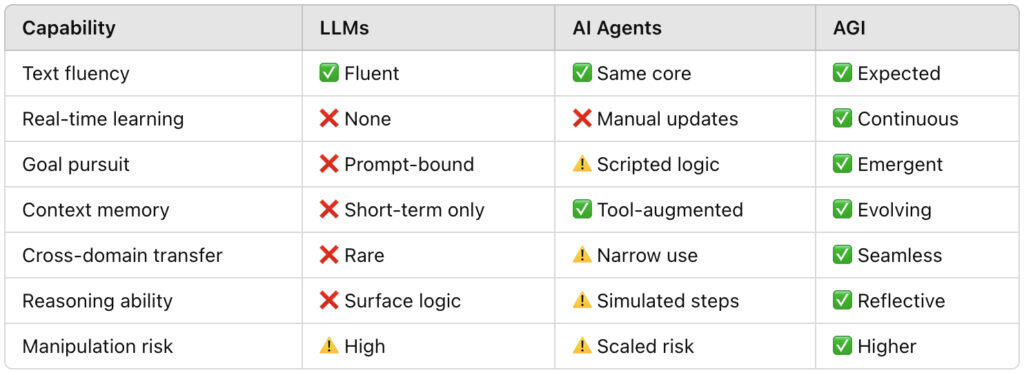
We don’t need AGI to be manipulated.
We just need to underestimate what LLMs can already do—and fail to notice who’s steering the output.
What the real opportunity looks like
This isn’t about rejecting AI. Or fearing it.
It’s about learning how to see it clearly.
Use it when it helps. Check it when it misleads. Ask smarter questions. Keep some friction in the loop. Be critical of unverified media news.
AI literacy isn’t just a tech skill anymore—it’s a survival skill.
Because if you don’t know what these tools are doing… someone else does.
Try this prompt
Want to test your AI’s grasp of learning?
“Explain the difference between next-token prediction and reinforcement learning. Use a metaphor involving cooking or sports.”
Try it in Perplexity, Claude, GPT-4.5, Gemini, or DeepSeek. Then ask yourself: Is this understanding—or just performance?
Let’s talk
- What’s one AGI fear you’ve had that feels different now?
- What’s one real risk or limitation you’ve seen up close?
- Know someone saying “GPT is basically AGI”? Send them this.
Until next time,
Mark
The AI Learning Guy
👋⚡😎
Quick reads
- AI in the Workplace (McKinsey)
- What’s next for AI in 2025? (MIT Review)
- Powerful AI is coming. We are not ready. (NYT)
- Human-level AI will be here in 5-10 years (CNBC)
- OpenAI Blog – AI research.
Note: No single website has all the answers. This list offers a starting point for those who want to roll up their sleeves or simply satisfy some AI curiosity. Links: No affiliate links included.
The AI Learning Guy newsletter 🤖 🧠💡
AI learning hacks and mega prompts delivered to your inbox.